


Working Principles of Fluorescence Endoscopic Camera Systems
Fluorescence endoscopic camera systems operate by directing a combination of near-infrared light (in the 750–810 nm band) and visible light onto human blood tissues that have been injected with Indocyanine Green (ICG). This process generates coupled light signals—specifically, excited fluorescence light peaking at 835 nm and visible light. These signals are then separated by a beam-splitting prism and received independently by a near-infrared sensor and a visible-light sensor. The system converts the optical energy into electrical signals, which are subsequently digitized. These digital signals are processed and fused by the host unit's image processor before being transmitted to a medical monitor for display.
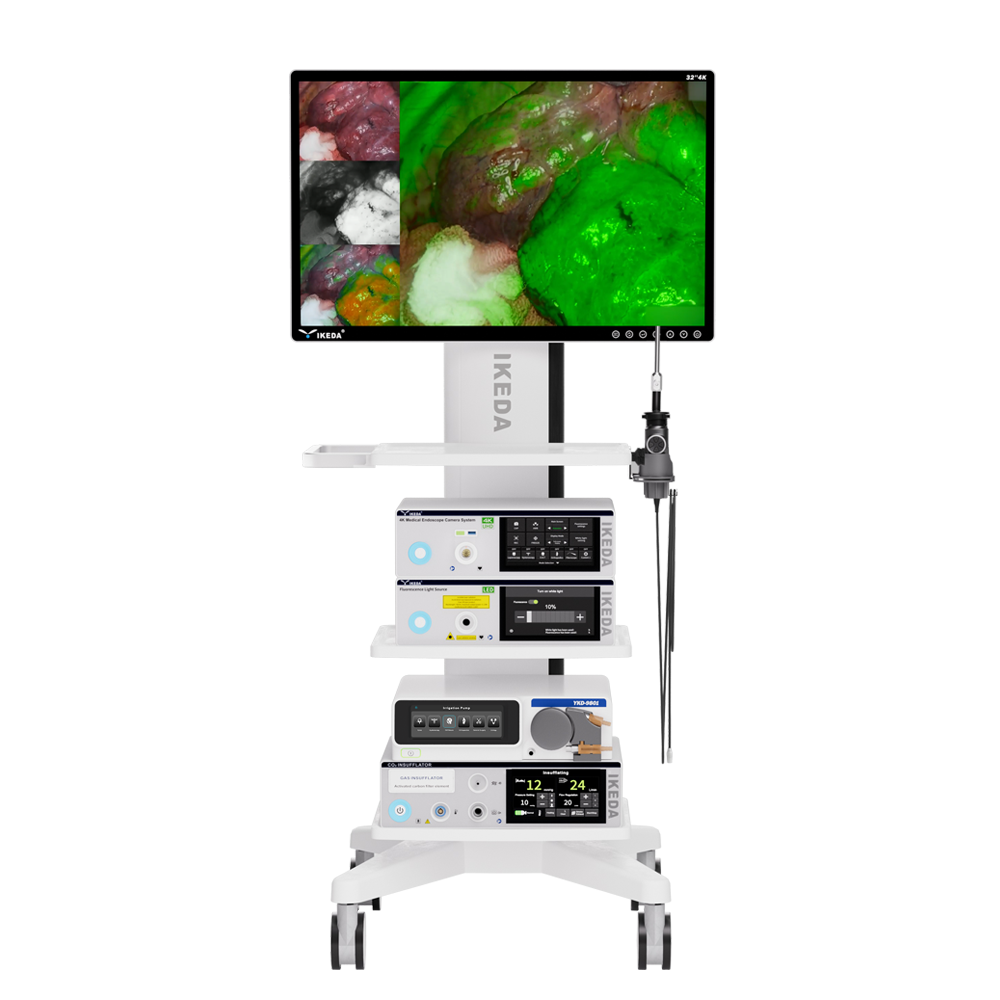
The "Luminescence" Principle of ICG Fluorescence
Following intravenous injection, ICG primarily binds with serum proteins and α1-lipoproteins to form large-volume ICG-plasma protein complexes. When these complexes are irradiated by lower-wavelength near-infrared light, their internal electrons undergo a transition from a low-energy level (ground state) to a high-energy level (excited state). Subsequently, these electrons release energy as they return from the high-energy level to the low-energy level. During this process, the released energy manifests as light waves of a specific wavelength, thereby generating fluorescence. Upon being captured by the infrared sensor, these fluorescence light waves are converted into electrical signals; these signals are then digitized via DC conversion, processed by the image processor, and finally transmitted to a display monitor.
Introduction to the Basic Imaging Principles of ICG Fluorescence Camera Systems
Indocyanine Green (ICG)—also known as Indocyanine Green or Fox Green—is a tricarbocyanine dye. It is the only dye approved by the U.S. Food and Drug Administration (FDA) for *in vivo* (within-body) diagnostic and therapeutic applications, and it possesses excellent fluorescence "luminescence" characteristics. Fluorescence endoscopic camera systems leverage these specific fluorescent properties of ICG and are frequently utilized in minimally invasive surgeries for applications such as tumor demarcation, lymph node dissection, and blood supply assessment.
ICG Fluorescence Camera Systems Are Now Widely Applied in Clinical Surgery:
Hepatobiliary Surgery
Primarily used for the diagnosis and surgical navigation of conditions such as hepatobiliary tumors, bile duct stones, hepatic fibrosis, and cirrhosis. By administering ICG intravenously—either *in vivo* or *ex vivo*—the system causes lesions to become visible under fluorescence excitation light, thereby enabling the clear and precise localization of pathological sites. **Gastrointestinal Surgery**
Primarily utilized for the diagnosis and localization of gastrointestinal tumors, sentinel lymph node dissection, assessment of anastomotic blood supply, and tissue perfusion monitoring. During surgery, fluorescence imaging enables the precise localization of tumor margins—thereby preventing incomplete tumor resection—and plays a crucial role in avoiding damage to vital blood vessels during blood supply assessments.
Gynecology
Primarily used for the visualization and localization of sentinel lymph nodes, delineation and resection of tumor margins, management of endometriosis, and assessment of tissue blood supply. Under ICG fluorescence, normal and pathological tissues exhibit distinct fluorescent characteristics, facilitating a more comprehensive detection and treatment of lesions by the physician.
Thoracic Surgery
Primarily applied in the early diagnosis and navigational localization of lung cancer, diagnosis and differentiation of pleural effusions, diagnosis and assessment of mediastinal tumors, as well as surgical navigation and intraoperative monitoring. By utilizing an ICG fluorescence imaging system to visualize pathological tissues, surgeons can more precisely localize lesion boundaries, thereby enhancing surgical outcomes.
Urology
Applications include tumor diagnosis and localization, surgical navigation and assistance, and assessment of urinary tract obstruction. Fluorescence endoscopy employs specific wavelengths of light to excite pathological tissues, causing them to emit fluorescence that differs markedly from that of normal tissues. This aids physicians in detecting minute or flat lesions—particularly those that are difficult to discern under standard white light—thereby significantly improving the lesion detection rate.
Thyroid and Breast Surgery
Encompassing both thyroid and breast surgical procedures, intraoperative fluorescence imaging enables the accurate identification of lesions, facilitating their precise resection while safeguarding the surrounding glandular tissue and minimizing the risk of postoperative complications.
Neurosurgery
Via transnasal endoscopy: visualization of the internal carotid artery, pituitary tumors, and intranasal masses. Via transcranial endoscopy: fluorescent labeling of vascularized tumors (such as hemangioblastomas), endoscopic third ventriculostomy, and endoscopic assessment of the efficacy of aneurysm clipping.
For more information regarding fluorescence endoscopic imaging systems, please follow Yikeda!