


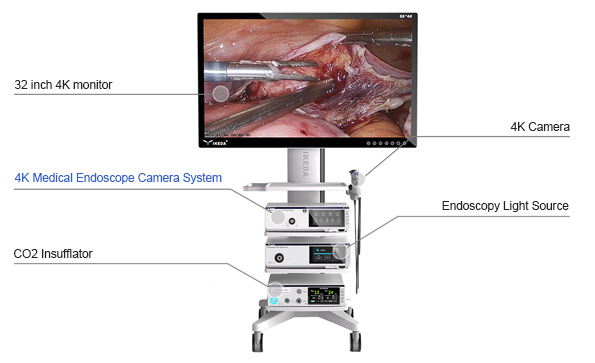
The principle of laparoscopic surgery is that, under cold light illumination, a camera system connected to the body cavity clearly images the tissues within the cavity and displays them on a monitor. Guided by the monitor images, the surgeon manipulates surgical instruments externally to perform procedures such as exploration, tissue dissection, electrocoagulation, hemostasis, emulsification of diseased tissue, resection, and suturing.
Laparoscopic tower includes an imaging system, laparoscopy, CO2 Insufflator, an Endoscopy Irrigation Pump, and Electronic surgical Unit.
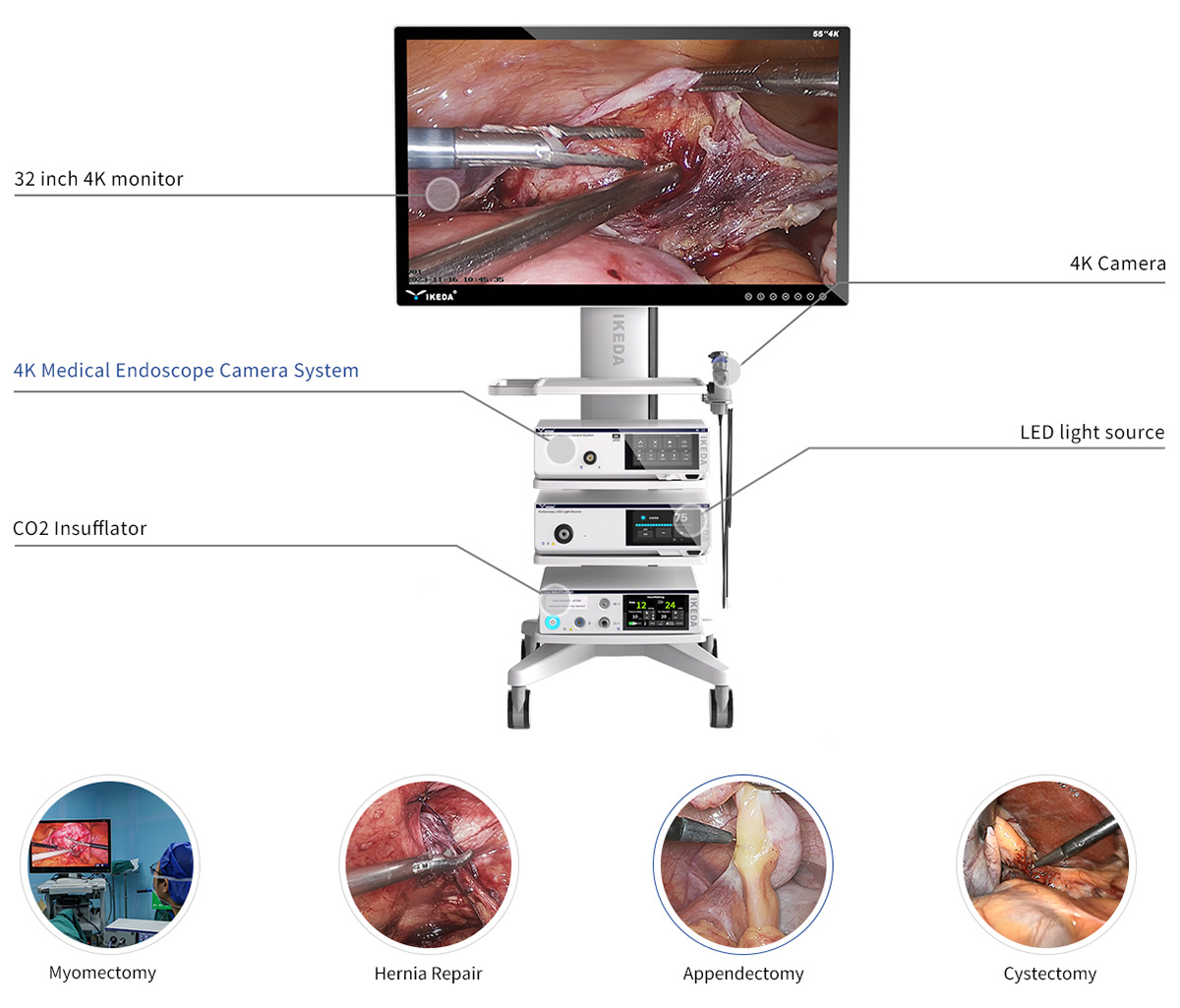
1. The imaging system includes: the endoscopic camera unit, Endoscopic Light Source, Endoscope Light guide, endoscopic camera, and medical monitor. It is the core of the endoscopic system, responsible for illuminating, acquiring, processing, transmitting, and displaying endoscopic images.
2. Laparoscope: Laparoscopes come in diameters of 10mm and 5mm, with viewing angles of 0°, 30°, 45°, and 70°.
3. CO2 Insufflator system: This includes pneumoperitoneum needles and a pneumoperitoneum machine. The pneumoperitoneum system creates surgical space by injecting carbon dioxide gas into the abdominal cavity.
3. Surgical Instruments: There are many types of instruments, commonly including dissecting forceps, grasping forceps, scissors, needle holders, trocars, and electrocautery hooks. The choice depends on the surgical needs and the surgeon's habits.
4. Endoscopy Irrigation Pump and Suction System: This is a crucial system for maintaining a clear surgical field.
5. Electronic surgical Unit: This provides various forms of energy to perform operations such as cutting and hemostasis.
The above is a brief introduction to the basic components of a laparoscopic system. For more information, please contact us!